Still have work to finish?
Exercise can wait. Until tomorrow, too, if work spills over.
Then someone tells you that entrepreneurs who lift heavy weights supposedly earn more money.
True or false? Maybe their income simply gives them more time to train.
The question that interests me more is: what do those hours of exercise change in your day?
Not just in the mirror. In your ability to keep an appointment with yourself, even when work gives you no breathing room.
Where does this story about exercise and money come from?
14% to 17% more income: that is the between physically active and less-active men in a scientific study of 5,042 individual male twins in Finland.
In China, another scientific study based on a survey of 20,783 people estimates 3.79% higher modeled personal income among regular exercisers, compared with a in which they did not have that habit.
Pieter Levels named a basket of shares in companies led by athletes the “.” But share prices are not executives’ income.
Prepare before you need to
I planned my workouts, tracked my progress, then applied the same approach to adjusting plans elsewhere in my life.
When the week still has room to breathe, there is always more work to do. That is when I can for exercise.
Once the work piles up, moving an appointment becomes much harder. This is not about heroic willpower.
Running a business can feel like an extreme sport: making decisions, owning them, and starting again as the day drags on. One bad week can cost the business dearly. Preparation does not remove the pressure. It keeps you from trying to build a routine in the middle of the storm.
An athlete trains before the competition. You can prepare before the high-pressure weeks, too.
Training does not replace sleep. Sometimes, work is what needs to slow down.
Moving can help. Too much can drain you.
A meta-analysis of 81 trials involving 7,050 people found, on average, less and more perceived energy in exercise groups than in control groups.
For , another review of 28 meta-analyses involving adults with varied backgrounds found a median reduction in symptoms with physical activity compared with usual care.
That is reason enough to want to move: a little activity might help you feel less tired and less anxious. But packing more into an already full week is a bad trade.
If you plan everything, first leave some free time for the unexpected. Then choose a short workout that fits into the remaining space without cutting into sleep. If there is no space left, lighten the week before adding exercise.
Your work also depends on your physical health
Tomorrow, back pain keeps you from sitting in front of the screen. The decisions and meetings are still there. You have to move them, delegate them, or handle them despite the discomfort: your body is part of your workday, too.
I have seen entrepreneurs suffer from back pain badly enough to affect their work. When every decision goes through you, your unavailability slows the business down, too.
Moving regularly does not guarantee a pain-free back. If the pain persists or gets worse, do not push through it just to save a workout: seek appropriate professional advice.
Do you budget for unexpected costs when cash flow is healthy? Making time to move follows the same logic.
An essential confidence boost
When you run a business, you cannot anticipate every decision or surprise. If, like me, you often doubt yourself and overthink things, having a simple plan and following it can be reassuring.
When I schedule a workout and complete it, I can see that I kept that appointment with myself. You can also record the movements and weights you used to see what is improving and what needs to change next time. Following that plan gives me something solid to lean on when the rest of the week shifts.
It does not guarantee that I will sign contracts. But the confidence I gain from something concrete helps me face the unexpected.
There is no need to wait for the perfect program. The World Health Organization notes that any amount of physical activity is better than none.
I couldn’t be bothered to go to the gym. So I started at home.
When I started, I knew I wouldn’t feel like going to the gym. So I worked out at home.
At home, I could exercise hard enough without adding the commute. That was enough to get me started.
On a busy evening, the commute alone can be enough to derail the workout. At home, you can keep a shorter version for days when time is tight.
A missed workout also gives you information: a poorly chosen time, too much travel, or an overly ambitious program. Adjust one variable and try again. The plan must adapt to the week, not the other way around.
So, what about the money?
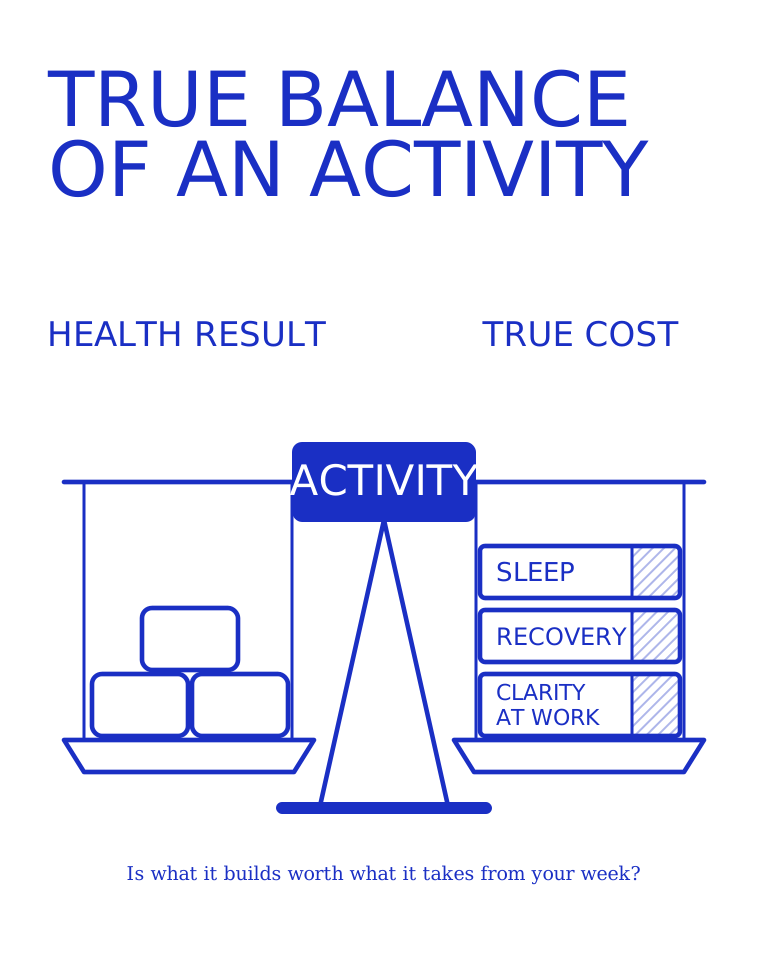
In my daily life, the calculation is simpler: keep a workout I can repeat, notice how I feel, and adjust the plan when the week changes. Research on fatigue and anxiety offers reasons to try it; it does not promise higher income. If I arrive at work with more capacity, I still have to decide what to do with it.
The starting point has to fit into your week: a workout simple enough to repeat even when work spills over. If pain requires precautions, adapt it with a professional.
The first result may not appear in your bank account. You may see it on the evening when your plan holds up, without leaving you even more exhausted.
Sources
- Hyytinen and Lahtonen, income records spanning fifteen years for Finnish male twins (Social Science & Medicine, 2013): https://www.sciencedirect.com/science/article/abs/pii/S0277953613004188
- Xiao and colleagues, 2016 Chinese survey and modeled income estimates (Nutrients, 2022): https://www.mdpi.com/2072-6643/14/17/3522
- Pieter Levels, his personal presentation of the “Deadlift ETF” and its comparison with the S&P 500 (a claim, not a scientific study of income): https://levels.io/deadlift-etf-ceos-lift-weights-outperforms-sp500
- S&P Dow Jones Indices, overview of the S&P 500 and its composition: https://www.spglobal.com/spdji/en/documents/additional-material/sp-500-brochure.pdf
- Pieter Levels, overview of Nomad List and his business: https://levels.io/nomad-list-founder
- Wender, Manninen, and O’Connor, meta-analysis of 81 trials on perceived energy and fatigue (Frontiers in Psychology, 2022): https://pmc.ncbi.nlm.nih.gov/articles/PMC9206544/
- Singh and colleagues, review of 97 trial syntheses on depression, anxiety, and distress (British Journal of Sports Medicine, 2023): https://bjsm.bmj.com/content/57/18/1203
- World Health Organization, Physical activity fact sheet and guidance for getting started: https://www.who.int/news-room/fact-sheets/detail/physical-activity
- Peng and colleagues, planning and physical activity: https://pmc.ncbi.nlm.nih.gov/articles/PMC9223740/
Cuong · Paris