This mistake was supposed to save me time.
It cost me 60% of the expected margin and part of my reputation.
I still think about it today.
At the time, my studio was working on a major project for a .
The deadline was tight, and I thought I could protect the project by sacrificing a few more nights.
In reality, I was spending the very resource I needed to save it: my ability to think clearly, sustain effort, and absorb the unexpected.
That’s what I call your Biological Capital.
It can erode for a long time without stopping you from working. But every decision becomes more costly, and every mistake becomes harder to fix.
In this article?
I’ll show you the three reserves that make up this capital. How to identify the one holding you back. And what I changed to escape this trajectory before it did lasting damage to my health.
It all started that night…
The rational decision that triggered the domino effect
It’s almost 3 a.m.
The deadline is tight. The entire team is waiting for the previous stages to be approved before moving forward.
At that moment, one step seems expendable.
So I remove it.
On paper, the calculation seems rational:
- we gain a few hours;
- we protect the deadline;
- we avoid slowing down the entire team.
The problem is that I don’t account for the state I’m in when I make that calculation.
I’m tired. My attention has narrowed, and I’m looking less for the right decision than for the shortest way out of the problem.
So I make the call.
And for a few hours, it works.
The project moves forward. The team gets back to work. I even feel like I’ve broken the logjam.
Then the first consequences appear.
Removing that step weakens everything that follows. Corrections start piling up. Each correction pulls someone in, delays another task, and puts more pressure on the deadline.
To absorb the delay, I work even later.
Which makes me more tired.
Which pushes me to look for more shortcuts.
The vicious cycle has begun.
With each new problem, I use the same solution: take a little more from my sleep to avoid slowing down the project or having a difficult conversation.
In the moment, I think I’m protecting my company.
In reality, I’m borrowing against my own decision-making capacity to repair the consequences of my previous decisions.
And that debt doesn’t show up immediately.
I keep working. I answer messages. I deliver files. From the outside, I just look deeply committed to my project.
That’s exactly what makes this trajectory dangerous.
I don’t see myself as someone burning out.
I see myself as ambitious.
Burnout knows how to disguise itself as ambition
After that project and the loss of reputation that followed?
I often think back to the moment when everything could still have been avoided… I’m sitting in front of my screen. The deadline is approaching. I know I should warn the client, reduce the scope, or face a difficult conversation with the team.
But I don’t. Instead, I say yes.
Yes to the deadline. Yes to the requests. Yes to the extra hours.
Then I take the difference out of my sleep.
In the moment? It looks like ambition. I work more than everyone else. I reply at 1 a.m. I always find a way to keep going.
In reality, I’m not confronting the problem. I’m paying for it with my energy.
And the longer I postpone the difficult decision, the more expensive it becomes.
I sleep less to keep my commitments. Fatigue impairs my attention and , and therefore my ability to make trade-offs. I find it even easier to avoid uncomfortable decisions, then accept new constraints I can no longer absorb.
That’s how burnout disguises itself as ambition.
Fatigue doesn’t stop you from deciding. It lets a diminished version of you make the decision.
That’s what I didn’t understand.
I thought my advantage came from my ability to work longer.
In reality? It came mostly from my market experience and my ability to make the right decision at the right time.
But that experience is useless if your environment no longer lets you access it with enough clarity.
Two clear-headed hours can be worth more than twenty-two hours of diminished work.
An extra hour is worthless if it increases the risk that you’ll have to repair tomorrow what you decided tonight.
That’s also what makes research on entrepreneurs’ ages interesting.
In the United States, founders of companies in the top 0.1% for growth were 45 years old on average. Not because an ideal age exists, but probably because they had accumulated more .
Other research shows that our cognitive abilities don’t all peak at the same age. Some forms of speed peak fairly early, while knowledge and experience continue growing for much longer.
Your advantage isn’t staying able to absorb everything.
It’s protecting the conditions that let you use what you’ve learned properly.
Sometimes that means saying no, slowing down, or facing a difficult conversation before it becomes a crisis.
Because it’s better to break an expectation today than let your body fail tomorrow and watch the whole system collapse with it.
Because in a company, nothing breaks alone.
One bad night impairs your judgment.
Your judgment impairs a decision.
And that decision can ripple through the entire company.
How far?
It all depends on the leverage it carries.
The more leverage you have, the more a bad decision costs
In my case, it all starts with removing one step to save time and increase my margin.
At the first order? The decision seems to work: I recover a few hours of work.
Except the calculation doesn’t end there.
At the second order? The entire team has to adapt, and the project’s quality becomes more fragile.
Then comes the third order… Corrections pile up, the client relationship deteriorates, and my reputation ends up paying the rest.
The decision was supposed to increase my margin.
In the end, it costs me 60% of what I’d expected.
Ray Dalio calls these : everything a decision causes after its immediate result.
That’s exactly what leverage amplifies.
A single decision can move far more time, money, and work than it takes to make.
A signature commits a team. A poorly set price can affect an entire year. A contract read too quickly can follow you for months.
Naval Ravikant sums up the challenge well:
« The quality of our decisions is paramount in the modern age, because we're all leveraged. »
The more execution a decision triggers, the more the quality of the judgment matters.
At first, you can still make up for a mistake with a few hours of work.
Then the company grows.
The same mistake pulls in a team, commits a budget, or weakens an important relationship.
And then you can no longer fix everything alone overnight.
Your advantage no longer comes from your ability to work more.
It comes from your ability to remain clear-headed enough to use the leverage you’ve built properly.
That’s why health matters to me here.
Not to become an “optimized” version of myself.
Simply to keep a decision made in a diminished state from spreading through everything I spent years building.
Health doesn’t guarantee a good decision.
It protects the tool that must make it: your Biological Capital.
And protecting that tool for a few weeks isn’t enough.
The real question is how many more years you’ll be able to use it fully.
Adding years isn’t enough if you lose your abilities
When we talk about longevity, we often conflate three ideas.
Longevity is the total length of your life.
Healthspan is the number of years you remain independent enough to do what matters.
And function is what you can still do in practical terms: think clearly, sustain effort, carry a load, or get up from the floor.
For an entrepreneur, the most useful concept is therefore useful lifespan.
These are the years when you can still choose, act, and absorb the unexpected without the entire system grinding to a halt.
The challenge isn’t to exercise more and more.
It’s to find the level of activity that lets you live a long life, remain physically capable, and keep enough clarity to think well.
For the vast majority of people, physical activity is insufficient.
And if you’re an entrepreneur, there’s a good chance you sometimes face a different problem: doing too much.
In my case, exercise gave me something my work couldn’t.
A workout starts. I know the exercises. I watch the reps add up. I can measure my progress.
For an hour, I replace the constant uncertainty of business with something concrete.
I push. I progress. I get an immediate reward.
The danger is chasing that certainty again and again until every workout becomes a test of willpower.
All day, you make decisions without knowing exactly what they’ll produce. That uncertainty creates tension. So you return to an activity where effort provides clear feedback.
You push a little harder.
Then a little harder again.
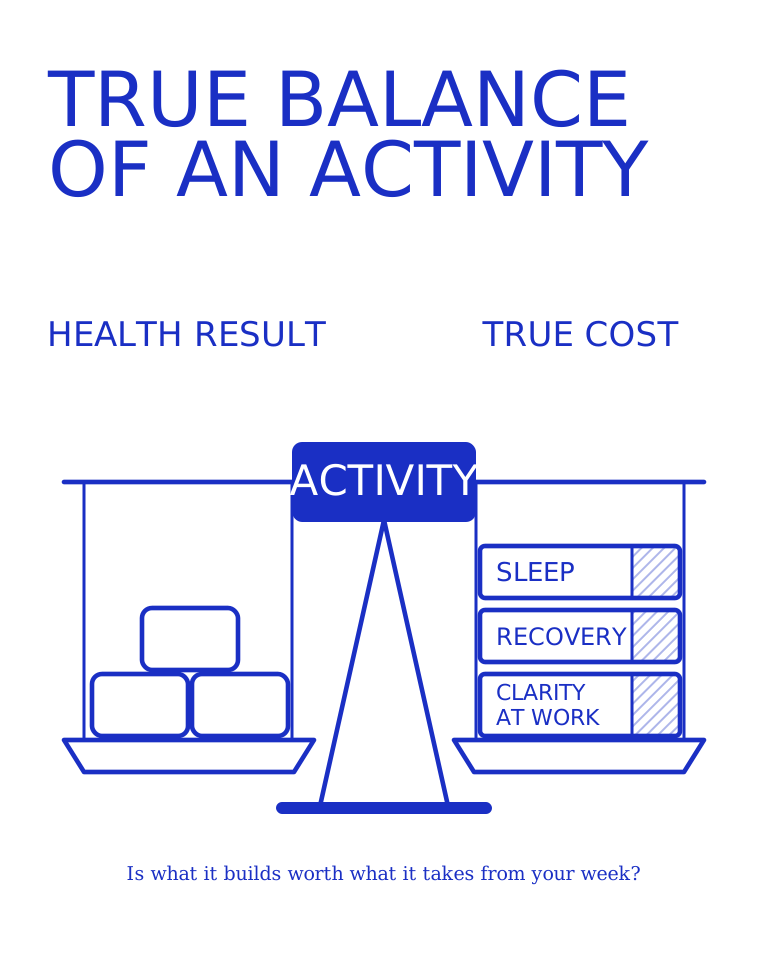
And without realizing it, the activity meant to support your energy starts draining your recovery and ability to think.
The right balance isn’t about maximizing physical activity or productivity.
It’s about preserving both:
- enough movement to support your lifespan,
- enough recovery and available time to keep your mind clear.
That’s what makes exercise so appealing to an entrepreneur: you quickly get feedback on your actions.
It’s a .
Entrepreneurship works differently.
You can execute well and still get a no, silence, or an ambiguous result.
The temptation is to return to what gives you immediate feedback: training, work, tasks you can check off.
And for some people, that logic eventually pushes them to do more and more.
The practice still looks healthy on paper. The dose can drain your Biological Capital.
So the useful question isn’t:
How many years can I add?
It’s:
For how many more years will I be able to think clearly, act, and absorb the unexpected?
To answer that, we need to stop treating “health” as one vague block.
We need to look at what it actually makes available to you.
Three reserves determine your useful lifespan
Researchers who study longevity and functional aging focus on three dimensions in particular:
- cognitive clarity,
- the ability to sustain effort,
- and physical resilience.
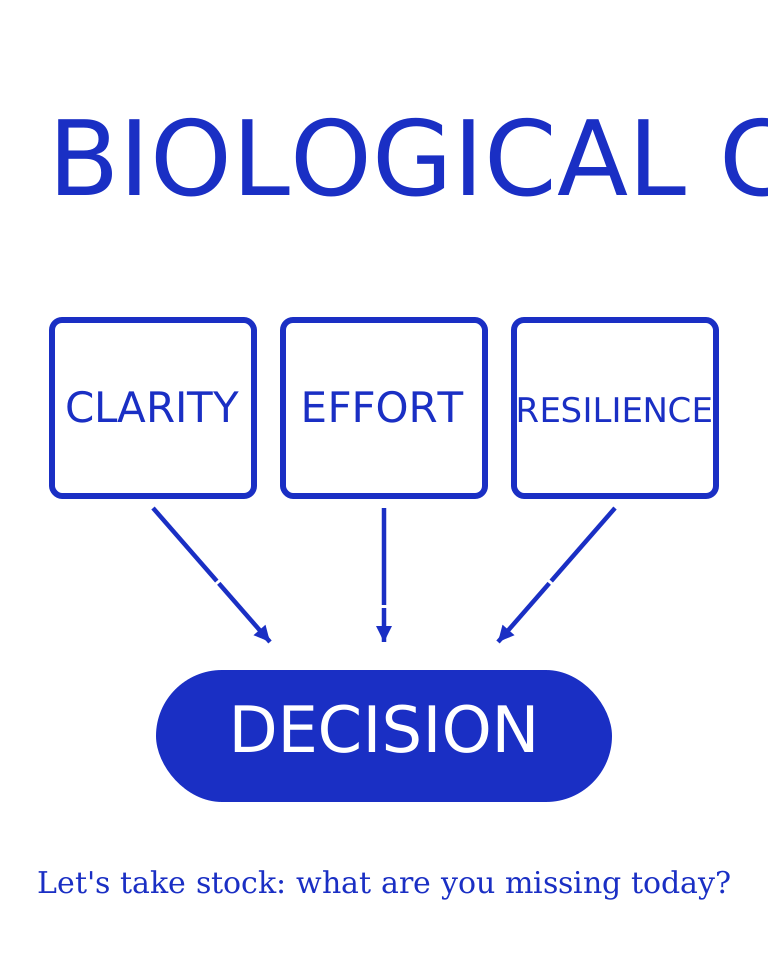
To make these dimensions more concrete, I group them here into three reserves of Biological Capital.
They all feed the same output: your ability to decide, act, and absorb the unexpected.
Clarity.
It’s your ability to think, make trade-offs, and stay calm after a difficult week.
It depends in part on sleep, recovery, attention, and mood.
When it drops, you lose perspective. You become more irritable and mainly look for ways to close out the issues bothering you.
Effort.
It’s your ability to sustain a load, then recover.
Climb stairs. Walk for a long time. Get through a demanding day. Do it again the next day.
—the heart and lungs’ ability to sustain prolonged effort—is associated with a lower risk of mortality and several chronic diseases. That doesn’t make your cardio a counter of years gained.
Resilience.
It’s the structure that supports effort: strength, muscle, bones, balance, and your ability to recover after strain.
Studies that follow groups over time associate strength training with lower mortality, though more volume isn’t always better.
The detail that changes everything?
Your Biological Capital doesn't work on averages: the weakest reserve eventually limits the entire system.
You can have excellent cardio and severe sleep debt: that debt will still shape your decisions.
You can also sleep well but lack so much strength that back pain turns every week into a survival operation.
This model helps you spot your limiting factor.
The question is simple:
Which reserve fails first for you?
This article simply lays out the map.
I’ll then devote a separate article to each reserve: clarity, effort, and resilience.
We’ll see what builds them, what drains them, and how to identify the one limiting you today.
Looking for the hack? These six fundamentals already determine your results
If you’ve developed real expertise in a field, you’ve probably noticed it: results rarely come from a hack.
They rest on a few first principles so basic that they eventually become invisible.
A detail can make a difference in a specific case. But no tool or protocol replaces the basics: sleeping enough, moving, eating well, and recovering.
Back then, I forget this. I confuse novelty with progress. I look for the next optimization while my reserves are already draining.
The same six fundamentals always return:
- Get enough sleep.
- Move regularly.
- Build cardio and strength.
- Eat well.
- Reduce obvious toxins.
- Seek medical care when needed.
These aren’t spectacular recipes. They’re the foundations that allow optimizations to work.
Without them, optimization often becomes an extra burden with better packaging.
The order I use fits into four verbs: subtract, build, measure, experiment.
Subtract what is already draining your reserves. Build with the basics. Measure only what can change a decision. Experiment last.
This approach echoes ’s via negativa: improve a system by first removing what makes it fragile.
Above all, it prevents you from piling a “healthy” habit onto an already saturated system: one more workout, a fast in the middle of a difficult week, or a tracker that produces numbers without changing your Monday morning.
Charlie Munger sums up inversion with a line that’s hard to forget:
« All I want to know is where I'm going to die, so I'll never go there. »
So yes, compounding matters. But before looking for the next optimization, look for the leak that keeps recurring.
A small leak eventually drains your reserve. A fundamental maintained over time rebuilds it.
The question then becomes simple: what criteria tell you whether you’re truly aligned with these fundamentals?
Find the reserve holding you back before adding anything
I fall into another trap.
During an especially busy period?
I intensify my strength training with . I think I’m protecting my energy. In reality, my capacity for work collapses.
Waking up becomes difficult, and my work slows to a crawl. So I go from five workout days a week to four.
Three months later? I even see muscle growth. I gain muscle with one less training day. Training more wasn’t producing more progress; it was mostly adding fatigue.
Since then? Whenever I decide to speed up, intensify my workouts, or reduce the load to find the right level again…
I return to the same benchmark:
- does this dose increase my ability to think and act,
- or does it draw from the reserve I’m trying to protect?
A healthy habit can also drain your reserves. The useful dose depends on the context.
Elon Musk’s deletion method applies the same logic to engineering:
- question the requirements,
- delete a step,
- only then simplify,
- finally, accelerate or automate.
If the team doesn’t need to reintroduce some of what it removed? Then it probably didn’t delete enough.
The makes this order visible: remove, observe, then reintroduce only what proves useful.
I apply the same logic to my reserves!
Example: For one week, I remove a single reversible burden: a workout added out of guilt, a metric I never check, or a commitment with no consequences.
I observe what changes in my sleep, energy, and clarity. If the system deteriorates, I reintroduce the burden. If nothing is missing, I’ve recovered some margin.
The goal is to avoid making more effort for nothing.
So? The sequence comes down to three moves: remove, observe, reintroduce.
This test doesn’t provide a diagnosis. It helps you choose a priority. If a symptom persists, worsens, or concerns you, talk to a healthcare professional.
The priority comes down to one thing: protect the reserve that fails first before adding another layer. If this framework helps, I invite you to follow me through my newsletter. I’ll send you the next installment :-)
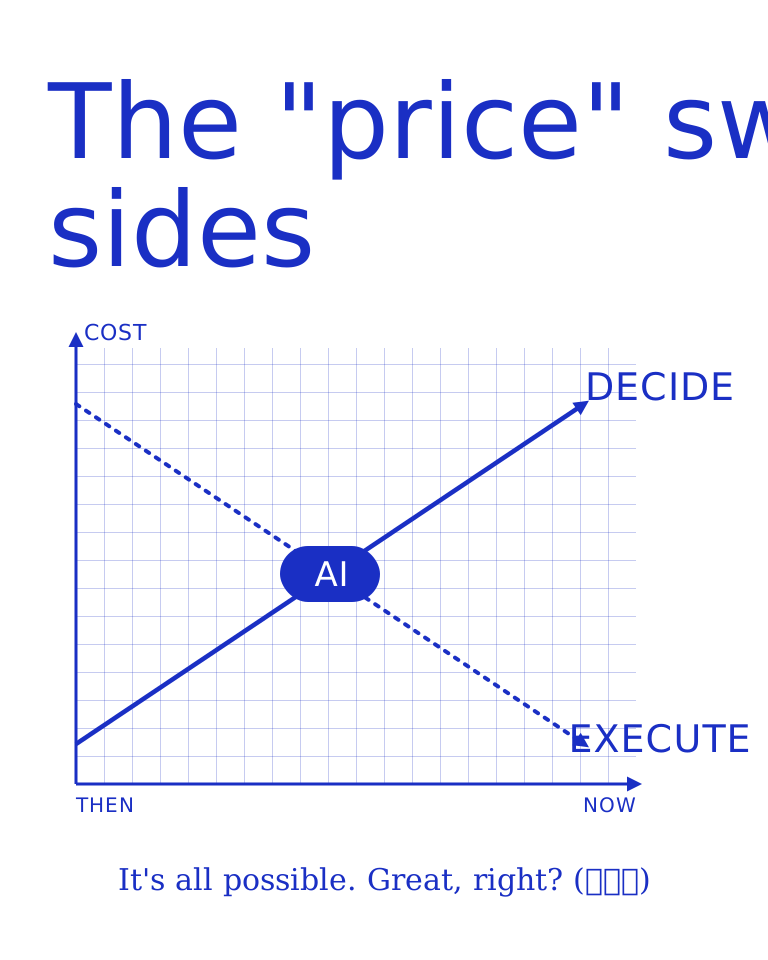
Protecting your Biological Capital doesn’t take time away from your company. It protects the person who decides where all that time should go. In my manifesto, I wrote about the cost of execution moving forward while decision-making falls behind: burnout goes hand in hand with ambition.
Your competitors are probably reading the same articles about performance. The difference will show later: who will still be able to make clear decisions ten years from now?
This article draws on the work of Vincent Foulonneau and Michael Gundill, followed by the research below to verify its key claims.
Hugs
Sources
- Lowe et al. (2017), sleep and cognition: meta-analysis of 61 studies on acute or short-term restriction, with an average effect that cannot explain a business decision on its own. https://pubmed.ncbi.nlm.nih.gov/28757454/
- Azoulay et al. (2020), age and high-growth entrepreneurship: data on 2.7 million American founders. https://www.nber.org/papers/w24489
- Hartshorne and Germine (2015), cognitive abilities and age: abilities don’t all peak at the same time. https://pmc.ncbi.nlm.nih.gov/articles/PMC4441622/
- Naval Ravikant, decision quality and leverage: an entrepreneurial perspective. https://nav.al/happiness
- Charlie Munger, the principle of inversion: Poor Charlie’s Almanack. https://www.stripe.press/poor-charlies-almanack
- Lang et al. (2024), cardiorespiratory fitness: synthesis of 26 systematic reviews, 199 cohorts, and more than 20.9 million observations. https://pubmed.ncbi.nlm.nih.gov/38599681/
- Shailendra et al. (2022), strength training: systematic review and meta-analysis. https://pubmed.ncbi.nlm.nih.gov/35599175/
- Zhang et al. (2025), supersets: comparison with traditional sets. https://pubmed.ncbi.nlm.nih.gov/39903375/
- Elon Musk, five-step engineering protocol, interview at Starbase with Everyday Astronaut. https://www.youtube.com/watch?v=t705r8ICkRw
Interviews
- Vincent Foulonneau, “How to stay young longer”: https://www.youtube.com/watch?v=P61N_-Tu54A
- Vincent Foulonneau, “How to slow aging”: https://www.youtube.com/watch?v=VERJiRii0BY
- Michael Gundill, longevity in strength training: https://www.youtube.com/watch?v=PXctQ2HuLig
- Michael Gundill, muscle mass and health: https://www.youtube.com/watch?v=NB8wnkMadaA
- Michael Gundill, sports nutrition: https://www.youtube.com/watch?v=2AWtbs1I6wc
Cuong · Paris