An hour of walking a day: is that enough to take care of your health over time?
If you have built that habit, you are already doing something useful.
Walking counts. It can support your mood and energy, two valuable things when you have a business to run.
What comes next depends on what you expect from that hour.
- Preserve your physical abilities?
- Support more demanding efforts?
- Or maintain a sustainable activity?
The same practice does NOT necessarily do it all.
As for me? At the time, I trained five days a week because I thought more exercise would automatically improve my health.
Then waking up became difficult, and my work slowed down…
To find my balance again, I cut back: take care of my health, build a body I like… without burning myself out.
So, not enough, enough, or too much? How do you assess your activity without guessing at an ideal number?
That is the question I wanted to explore through scientific research today :)
Effective for what result?
Preserving your health and building strength? Those are not exactly the same goals.
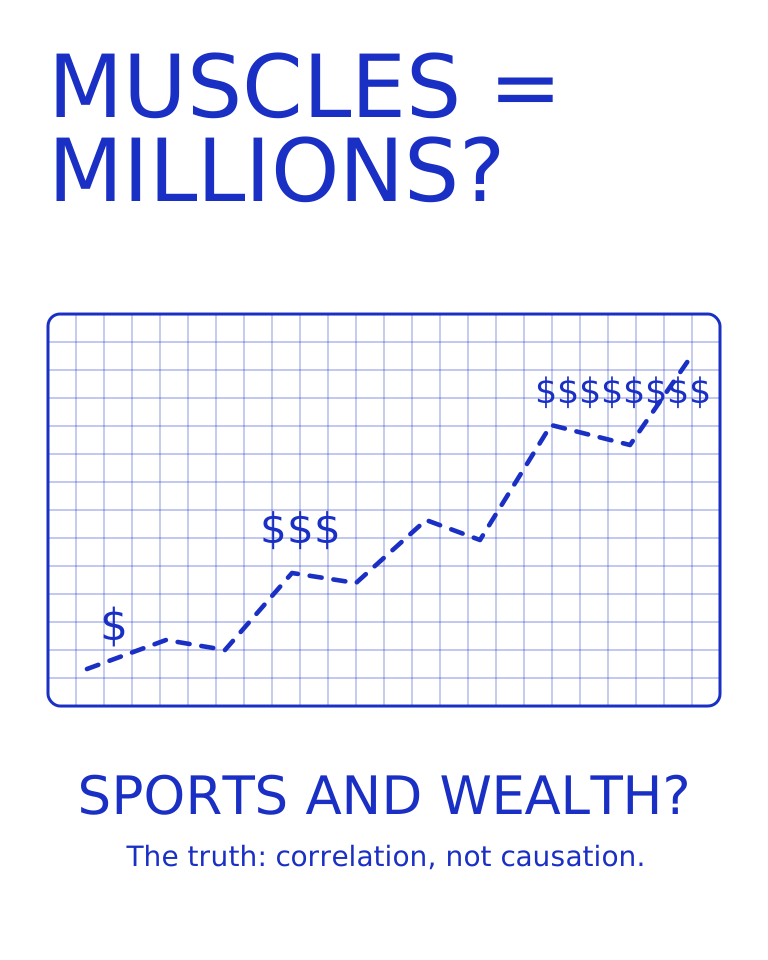
For general health? Walking has a role. Scientific studies that follow groups over time observe less among people who walk the most. A review combining 18 cohorts and 459,833 participants points in that direction.
That supports the value of walking without turning one hour a day into an individual guarantee.
For strength? That is different.
Strength is not just about lifting heavier weights. It helps you carry things, stand up, climb stairs, and keep something in reserve when daily life gets demanding.
As you age, preserving this also helps you remain independent longer.
To maintain it, walking more does not automatically replace suitable strength training.
You can therefore have a useful activity, then expect it to produce a result it cannot deliver on its own.
The first distinction that helps me? Before asking whether I do enough, I define what it is for.
For health, the guidelines give adults a useful benchmark.
Here is the benchmark:
- 150 to 300 minutes of moderate activity per week;
- or 75 to 150 minutes of vigorous activity;
- or a combination of both;
- with muscle-strengthening activity at least two days per week.
A leisurely stroll and a brisk walk do not require the same effort.
Time spent outdoors alone does not tell you exactly where you stand against these guidelines.
How you feel is not enough either. Feeling good after a few weeks cannot confirm a long-term health benefit. The guidelines still matter, even when everything seems fine.
For your own routine, this distinction changes the next decision.
If you want strength, the first question is about strength training. If you want to preserve your health, walking already has a role. Adding more time to the same activity is not always the answer to the result you are missing.
A useful activity does not automatically meet all your goals.
What the extra workout is worth
An activity can be effective while costing you more than necessary.
During a busy period at work, I trained five days a week and intensified my strength training by doing certain exercises back-to-back with little rest.
I wanted to be strong and athletic. To have a body I liked in the mirror… But it drained all my energy. At the same time, I wanted to grow my business.
And you have probably figured out which mattered most: my business.
So the idea was to protect my energy.
The problem? Waking up became difficult. My work slowed to a crawl.
So? Four days instead of five.
Three months later? The progress was still there, and I kept .
What does this story not prove? That the fifth day was useless.
What does it show? In my case, I could keep making progress with fewer training days.
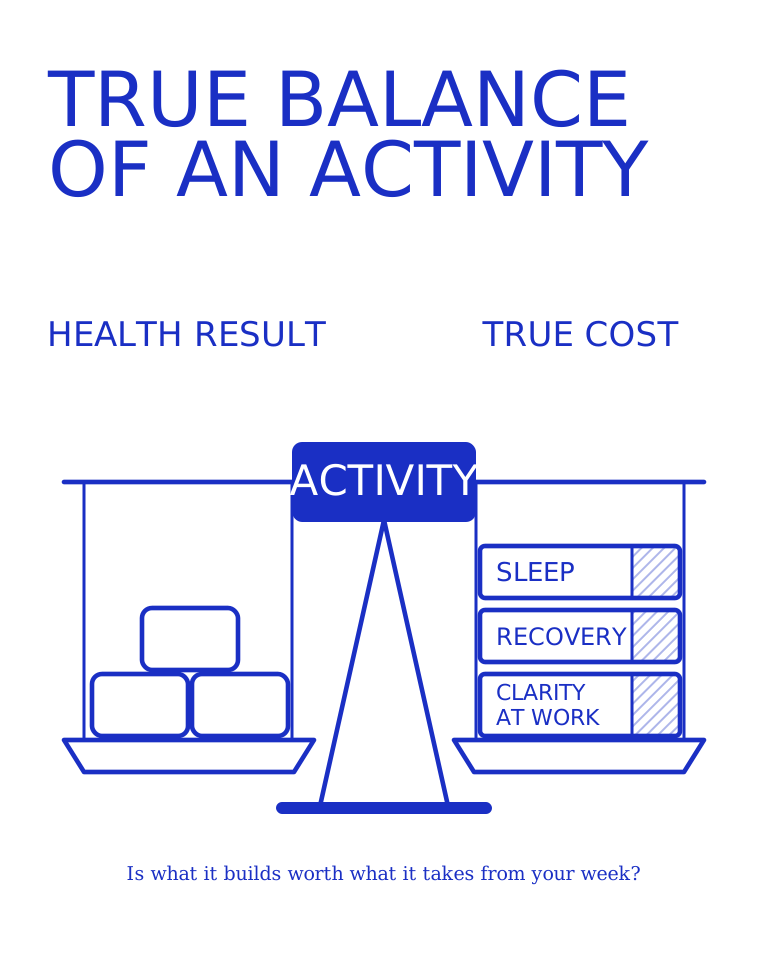
The cost did not stop at the gym. Difficult mornings and slower work were part of the bill, even though they happened outside my training time.
For long-term health, large reviews also give us reason to be cautious about adding more.
A pooled analysis of six prospective cohorts from the National Cancer Institute Cohort Consortium, published in JAMA Internal Medicine in 2015, followed 661,137 adults for a median of 14.2 years. Beyond the recommended activity level, the observed became more modest.
The key idea? Doing more does not deliver a proportional benefit with every addition.
The distinction matters.
When you move very little, getting started remains valuable. When activity already takes up a large part of your life, the extra workout deserves to be weighed against its cost:
- the time it takes;
- the recovery it requires;
- what it leaves for work and loved ones.
Effectiveness asks about the result. Efficiency adds the question of the price paid to achieve it. That second perspective was missing from my five training days.
“Zone 2”: how do you know whether the intensity is right?
Another answer seems tempting: keep your workouts, but make them easier.
There is a simple way to tell whether your physical activity is starting to benefit your cardiovascular endurance: look at its intensity.
Zone 2 offers a useful point of comparison. In some endurance models, it corresponds to an easy-to-moderate effort: hard enough to train your endurance, easy enough to sustain. It also lets you compare workouts and track your progress.
This zone is not the same for everyone. Its boundaries depend on the person and the method used to define them. A critical review published in Sports Medicine in 2020 found no consensus around a single method, and another review in 2025 concluded that the evidence does not establish Zone 2 as the optimal intensity for everyone. Measuring it precisely requires physiological data and suitable equipment.
No equipment? You still have the talk test, a benchmark validated in a 2015 randomized trial involving 16 physically active adults:
- you can speak comfortably, and the effort remains relatively easy;
- you struggle to finish your sentences, and the effort is becoming more intense.
This test can therefore help you estimate where you are around Zone 2. It gives you a point of comparison, not an exact measurement. A systematic review of 10 studies involving cardiovascular and pulmonary patients found it useful, but concluded that the protocol remains poorly defined.
The useful distinction? Walking faster changes the intensity. Walking longer or more often changes the quantity.
An easy effort repeated very often can still take up a lot of space. Conversely, an easy activity can already contribute to your health. Its difficulty alone does not tell you whether you are doing too much or too little.
A useful dose, then an adjustable one
These distinctions lead me to an idea: Minimum Viable Activity.
The definition? The smallest dose likely to be useful for the desired result, one you can repeat without placing an excessive cost on the rest of your life. I call this dose MVA, for Minimum Viable Activity, echoing the product-development concept of an .
The important word? Useful.
A dose can:
- be easy to maintain without meeting the goal, and need to be reconsidered;
- let you make progress with manageable recovery, without needing to grow;
- steadily make your days worse, even if it seems reasonable on paper.
MVA is a framework for thinking that I am proposing. It is not a medical threshold or a formula for calculating your exact minimum.
Zone 2 describes a possible intensity; MVA helps you think about the dose as a whole.
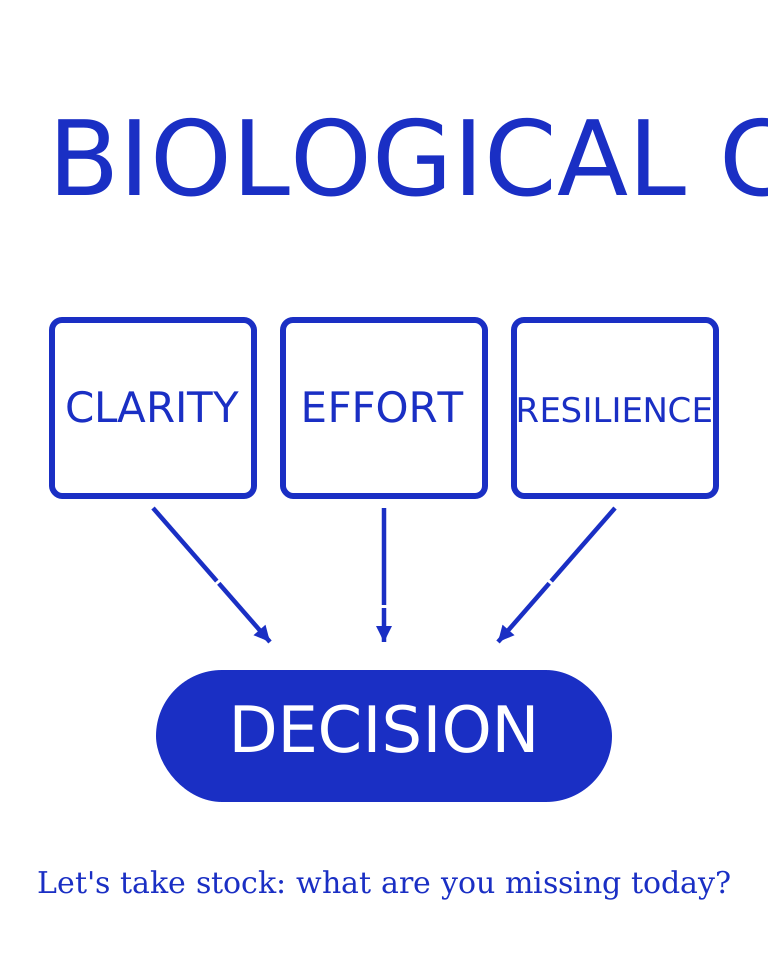
In my case, Biological Capital describes what I am trying to preserve: my ability to think, sustain effort, and recover.
That brings the rest of the day back into the decision.
Your original question returns with a more precise criterion: does this activity meet your goal at a cost your week can handle?
Finding the next adjustment
Do less? Not always.
The next adjustment depends on the signal:
- if the result is missing, there may be too little activity, the activity may be poorly suited to the goal, or another factor may need attention;
- if progress is there but your days are becoming difficult, the cost deserves more attention;
- if the whole routine remains sustainable, adding more becomes a choice that needs a reason.
For someone who walks and wants to build strength, the next step to explore would be suitable strength training.
For someone whose mornings get worse after adding workouts, it might be cutting back on that addition. Copying my four-day schedule would answer neither situation.
For the next change, the method remains simple:
- name what I am looking for;
- change only one thing;
- watch what happens over several weeks.
Tracking can remain simple. On one side, signs of progress related to the goal. On the other, waking up, sleep, energy, and the ability to do everything else.
The trend matters more than one isolated good or bad day. These observations help you ask questions; they do not prove a cause.
Persistent fatigue that worsens or causes concern calls for professional advice. And for long-term health, general guidelines still have a role: how you feel cannot replace what you cannot observe over a few weeks.
In my case, one fewer training day did not stop my muscle growth. That is not a dose I am prescribing to you. It is a reason to ask what each addition actually delivers.
A useful dose helps you progress. A sustainable dose lets you do it again.
So, your hour of walking? It can remain a solid foundation.
Depending on the result you want and what your week can handle, the next step may be a different effort, suitable strength training, or a lighter load elsewhere. Finding your right balance starts with understanding what is missing before filling one more slot in your schedule.
Sources
- Hamer and Chida (2008), walking and primary prevention: meta-analysis of 18 prospective cohorts, 459,833 participants. British Journal of Sports Medicine. https://pubmed.ncbi.nlm.nih.gov/18048441/
- Bull et al. (2020), World Health Organization guidelines on physical activity and sedentary behavior, published in the British Journal of Sports Medicine. https://pubmed.ncbi.nlm.nih.gov/33239350/
- World Health Organization (2024), the United Nations health agency, Physical activity fact sheet: all activity counts, including walking. https://www.who.int/news-room/fact-sheets/detail/physical-activity
- Radaelli et al. (2025), strength-training volume, physical function, lean mass, and strength in adults aged 60 and older: systematic review and network meta-analysis of 151 randomized trials, 6,306 participants. Sports Medicine. https://pubmed.ncbi.nlm.nih.gov/39405023/
- Arem et al. (2015), leisure-time physical activity and mortality: pooled analysis of six prospective cohorts from the National Cancer Institute Cohort Consortium, 661,137 adults, median follow-up of 14.2 years. JAMA Internal Medicine. https://pubmed.ncbi.nlm.nih.gov/25844730/
- Woltmann et al. (2015), the talk test and regulation of exercise intensity: randomized trial involving 16 physically active adults. Journal of Strength and Conditioning Research. https://pubmed.ncbi.nlm.nih.gov/25536539/
- Vieira et al. (2022), systematic review of 10 studies on the talk test in cardiovascular and pulmonary patients, 414 to 426 subjects depending on the section. Reviews in Cardiovascular Medicine. https://pubmed.ncbi.nlm.nih.gov/39076925/
- Jamnick et al. (2020), critical examination of methods for determining exercise intensity: review without its own sample. Sports Medicine. https://pubmed.ncbi.nlm.nih.gov/32729096/
- Storoschuk et al. (2025), critical narrative review of the evidence on Zone 2, mitochondrial capacity, and cardiorespiratory fitness. Sports Medicine. https://pubmed.ncbi.nlm.nih.gov/40560504/
- Cuong PHO, This Project’s Most Costly Decision Seemed Rational: a personal account of moving from five to four training days. https://cuongpho.com/blog/sante-premier-capital-entrepreneur
Cuong · Paris