Since 2025, AI has multiplied my productivity.
Okay, yes, great… And you know what? I also discovered the hidden price of that freedom.
Now that can code, write, and illustrate. Anything that crosses my mind can exist before the weekend is over.
That price?
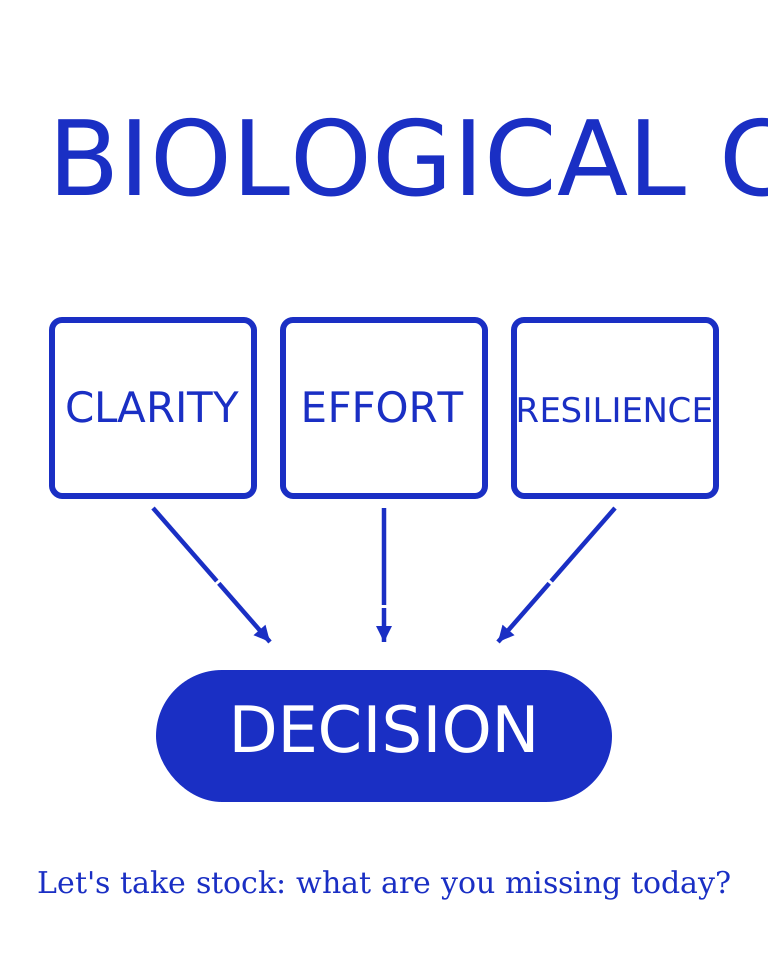
I pay it every day: scattered focus, followed by the weight of deciding.
Maybe you’ve felt it too: far more possibilities, far more ideas, but not necessarily more results that make it to the finish line.
If you create with AI, here’s what it has cost me—and the framework I now use to filter my projects.
Today? I’m sharing a few concepts that may keep you from falling into the same traps I did.
I’m not pulling them out of thin air: I dug through my reading notes and did fresh research.
Yes, this article is centered on Cuong PHO (me). Its first purpose is to help me clarify the subject. And who knows, it might help you too.
Ready?
When anything became possible, I lost focus
Before?
Executing an idea took months, a team, and a budget.
Your ambitions were filtered by default: too expensive, too slow, missing the skills. The filtering happened on its own.
That has disappeared. Today? When an idea crosses my mind, I can build it that same evening, at little cost.
I lived like that for months. Entire evenings spent building tools that nobody had asked for—not even me that morning.
I loved learning about AI, testing the latest AI , installing the newest GitHub plugin.
A tool that worked, left on autopilot while I rebuilt something else on the side… Projects open like browser tabs: none closed, all half-loaded.
The most deceptive part? Taken alone, every experiment was defensible. That’s what makes the trap invisible.
You never lose focus all at once. You lose it one good idea at a time.
The trap is rarely a bad idea. It's one good idea too many.
But the real change was somewhere else. And it took me months to see it.
It took me a while to understand what had changed
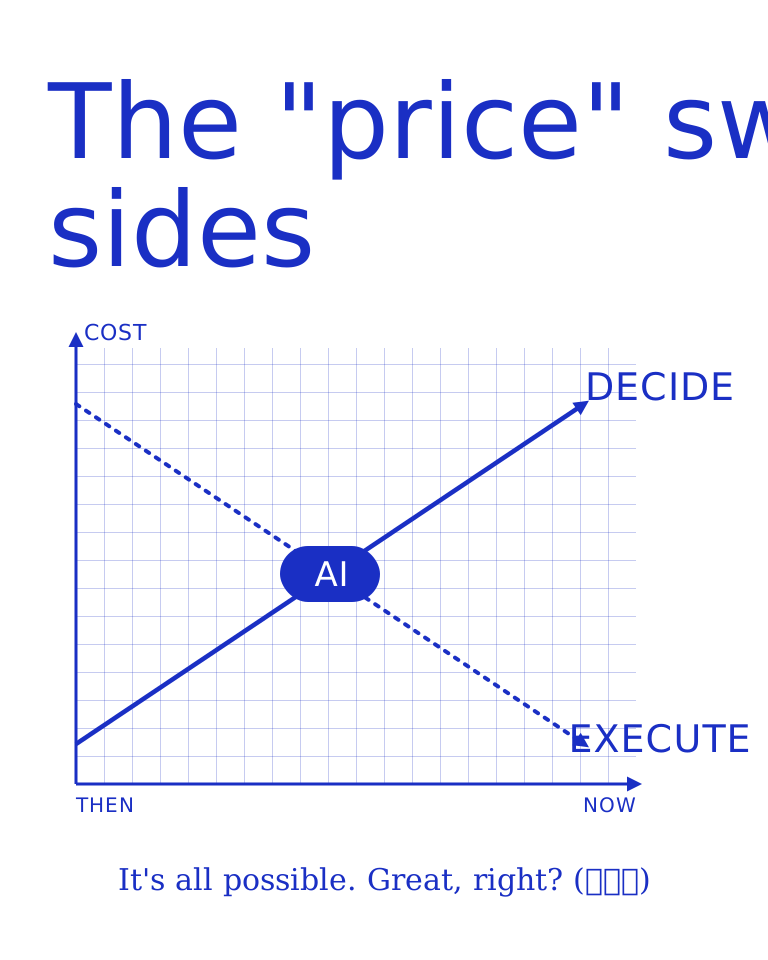
After falling into the same hole again and again, I finally understood what had changed: the price of things had been reversed.
Basically? Execution used to be expensive, while deciding seemed free. Choosing a project cost nothing because you could only do one anyway.
Now, generating costs almost nothing. Suddenly, deciding carries the full price.
At night, it became obvious very quickly: the machine produced and produced and produced. And it always handed the same thing back to me: choices.
The more I automated execution, the more one thing that nothing can automate remained at the bottom of the sieve: .
Every “painful” step I can’t delegate shows me where direction still lives. Remove all the friction, and sometimes you remove the steering wheel.
"The more advanced a control system is, so the more crucial may be the contribution of the human operator."
Every piece of execution I delegate also adds another layer I watch less closely.
The system grows. Blind spots appear: pieces keep running even though no one truly understands them anymore.
And those blind spots always send the bill eventually.
What this scattered focus really costs me
So what am I actually paying?
AI is probably the best-value expense of my life. The price is somewhere else.
First, attention.
Sophie Leroy calls it : after switching tasks, part of your mind remains stuck on the previous one. With several experiments open, each project charges its own tax, even on days when I don’t touch it.
So the right balance isn’t to stop experimenting. It’s to open enough experiments to learn, but not so many that I lose the thread.
Then there are the decisions I postpone. This realization hit me hardest: every experiment I launch is really a decision I’m not making.
Building a new tool instead of answering “does this project deserve to live?” feels comfortable. As long as I’m typing, I don’t have to answer.
The keyboard never says no. Reality does.
I’ve already described this escape in the story of the builder who codes to avoid selling. The mechanism is the same, only broader.
And the most expensive part: reality. While I experimented with everything, what already worked was waiting.
This is the hardest part to write: scattered focus doesn’t steal only time. It steals conviction from the things that deserved it.
So I created a framework. Not to experiment less. To decide more.
The framework I’m trying to use now
Stop experimenting? No.
Experimenting is how I learn, and this is the right time for it. What changes is the status of the experiment.
Charlie Munger, Warren Buffett’s longtime business partner, had a rule that took me a while to absorb: be ready to destroy your favorite ideas as soon as the facts turn against them.
A whole article later, I still fall for it.
Because AI has made Munger’s problem worse: it makes my favorite ideas buildable. An idea that stays on paper dies on its own. A half-built idea demands a sequel.
So my shift comes down to one sentence: every experiment must pay for its decision.
Now, before I start, I write down what the experiment must teach me and the date when I’ll decide.
No verdict date? It’s not an experiment. It’s an escape with a pretty name.
And the action that matters most is no longer adding. It’s deciding. Deleting, erasing, closing a project: that has become the most important work of all.
"It seems that perfection is attained not when there is nothing more to add, but when there is nothing more to remove."
Source: Wind, Sand and Stars, 1939
Experimenting is my school. Deciding is my job.
And really, it was all already there. I just had to name it.
What I’m trying to take away from all this
Reading back through what I’ve published here, everything was already pointing in this direction without naming it.
- I experiment: that’s how I learn, and I won’t give it up.
- I implement: because one tested idea is worth more than ten admired ones.
- And I decide: because it’s the only work the machine leaves me. And it’s the hardest.
The “I pay dearly” in the title is still true. I just know now what I’m buying with it.
Deciding when it feels uncomfortable—that’s what moves things forward.
Every experiment that ends with a decision creates . Every experiment that drags on without a verdict leaks judgment.
Opening an experiment gives me options. Closing it gives me judgment.
That judgment also has a physical cost I refused to see for a long time: health is an entrepreneur’s first form of capital, and exhaustion is very good at disguising itself as ambition.
And you—what do you already know you need to let go of?
Cuong · Paris